
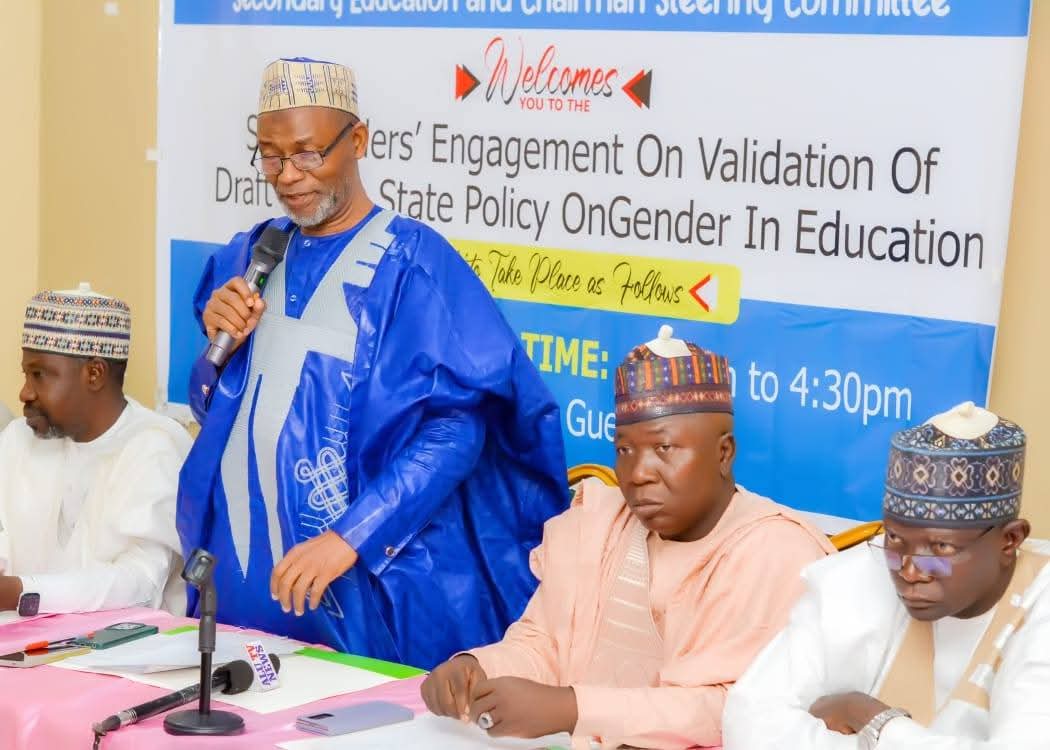
AGILE Leads Stakeholders’ Engagement to Validate Sokoto Gender in Education Policy
The Adolescent Girls Initiative for Learning and Empowerment has convened a stakeholders’ engagement meeting to validate the draft Sokoto State Policy on Gender in Education.
Declaring the engagement open, the Sokoto State Commissioner for Basic and Secondary Education, Ahmad Ladan Ala said the proposed policy aligns with national and international commitments, including the Sustainable Development Goals particularly Goal 4 on quality education and Goal 5 on gender equality as well as the nine point agenda of the current administration under Governor Ahmad Aliyu Sokoto.
Represented by the Commissioner for Higher Education, Prof. Isah Muhammad Maishanu, Professor Ladan described the exercise as a participatory process rather than a routine activity, urging stakeholders to contribute meaningfully.
“This engagement is not merely a formality. It is a participatory process. Your insights, experiences, and recommendations are vital in shaping a policy that is practical, inclusive, and responsive to the realities of our communities” he said.
He added that validating the draft policy would significantly promote equitable, accessible and transformative education for every child in Sokoto State. He reaffirmed the Ministry’s commitment to implementing inclusive policies that protect learners’ rights and strengthen the capacity of teachers and schools to deliver quality education.
In his welcome address, the Deputy State Coordinator of AGILE, Kabiru Garba Gobir, said the engagement aims to address gender disparity in education across the state. He emphasized that achieving gender equity requires strong collaboration among government agencies, development partners, and communities.
“Gender equity in education cannot be achieved by one institution alone. It requires collective effort” he said.
Dr. Gobir noted that Sokoto State continues to face significant challenges in bridging the gender gap in education, adding that AGILE has provided both financial and technical support to facilitate the domestication of the Gender in Education Policy.
He reaffirmed the initiative’s commitment to working closely with the Ministry, stakeholders, and communities to ensure effective implementation of the policy.
The meeting featured goodwill messages from key stakeholders, including representatives from the Ministry of Science and Technology, Shehu Shagari College of Education, the Agency for Mass Education, the Teachers Service Board, the Female Education Board, and civil society groups. Paper presentations also formed part of the engagement.
Participants were drawn from various agencies, departments, and parastatals under the Ministries of Basic and Secondary Education, as well as Science and Technology.
In his closing remarks, Assistant System Strengthening Officer, Alhaji Suleiman Musa, thanked participants for their contributions and encouraged continued engagement, noting that the policy document belongs to the people of Sokoto State.