Reforms Will Rewrite Nigeria’s Economic Story, Tinubu Says
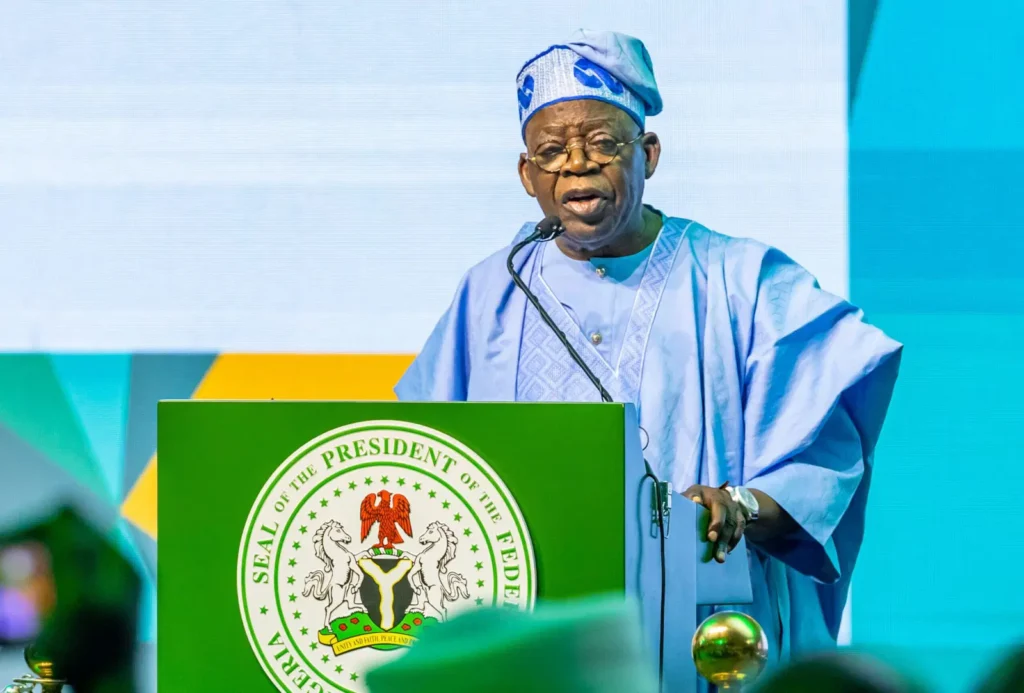
President Bola Tinubu has said his administration is working to reverse Nigeria’s longstanding economic underperformance through reforms aimed at removing structural barriers, boosting productivity, creating jobs and promoting shared prosperity.
Tinubu stated this on Monday while declaring open the 32nd Nigerian Economic Summit Group (NESG) Summit in Abuja, where he was represented by Vice President Kashim Shettima.
The President said his administration began with difficult economic adjustments because sustainable economic growth could not be achieved through shortcuts.
“We came to rewrite the story of a nation that has performed below its potential for far too long. But there is no shortcut to economic growth,” he said.
According to him, the reforms are intended to stabilise the economy, improve livelihoods and create opportunities for young job seekers, farmers, manufacturers, entrepreneurs and innovators.
He stressed that Nigeria must establish a stable economic environment that encourages both public and private sector investment, business expansion and productive employment.
Tinubu noted that the summit’s theme, “Growth That Works: Delivering Jobs, Productivity and Shared Prosperity,” aligned with the national ambition of achieving a prosperous and inclusive Nigeria by 2030.
He said the government had introduced reforms to address structural challenges that had prevented the country from fully benefiting from its abundant human and natural resources.
The President cited National Bureau of Statistics figures indicating that Nigeria’s inflation-adjusted Gross Domestic Product grew by 3.89 per cent in the first quarter of 2026, compared with 3.13 per cent in the corresponding period of 2025.
He added that non-oil activities accounted for 96.08 per cent of GDP, while manufacturing and the oil sector grew by 3.29 per cent and 2.57 per cent, respectively.
Tinubu also disclosed that capital importation reached $10.37 billion in the first quarter of 2026, representing an 83.83 per cent increase over the corresponding period in 2025.
He said the government would sustain efforts to improve regulatory transparency, strengthen policy predictability and expand access to finance to attract more domestic and foreign investment.
On employment, the President acknowledged that economic progress must go beyond favourable statistics, stressing the need to improve the quality of jobs, reduce underemployment and make better use of Nigeria’s workforce.
He maintained that infrastructure investment should be measured by the economic activities it generates, while education should be assessed by the skills and productivity it delivers.
Tinubu further outlined ongoing reforms in the electricity market, agriculture and solid minerals, including efforts to attract investment in power generation and distribution, improve irrigation and mechanisation, strengthen rural infrastructure and promote local processing of mineral resources.
Despite the progress recorded, he admitted that much work remained to be done, noting that Nigeria must translate economic recovery into tangible improvements in citizens’ living standards.
Meanwhile, United Nations Deputy Secretary-General, Dr Amina Mohammed, acknowledged the gains from the ongoing reforms but urged the Federal Government to consolidate the achievements, stabilise the economy and manage public expectations effectively.
She also commended the African Development Bank for its development financing initiatives across the continent.
The Minister of Finance and Coordinating Minister of the Economy, Dr Taiwo Oyedele, presented the proposed Nigerian Economic Policy Framework, describing it as a national guide for economic decision-making and measuring progress.
Oyedele called on members of the NESG and private-sector experts to critically examine the draft framework and contribute evidence-based recommendations. He identified enterprise, fair and open markets, and policy coordination across government as key principles of the proposal.
In his remarks, NESG Chairman Olaniyi Yusuf said the responsibility before economic experts was to help stabilise the economy and improve the implementation of existing reforms rather than advocate a reversal of the policies.
Similarly, BUA Group Chairman and Founder, AbdulSamad Rabiu, commended the reforms, particularly improvements in foreign exchange access, which he said had helped create a more predictable operating environment for businesses.
Rabiu, however, acknowledged the difficulties faced by ordinary Nigerians during the adjustment process.