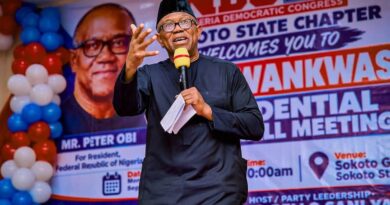
APC Campaign Council Challenges Obi Over Anambra Debt, Unpaid Salaries
By Nafiu Muhammad Lema
The All Progressives Congress (APC) Presidential Campaign Council has challenged the presidential candidate of the Nigeria Democratic Congress (NDC), Peter Obi, over his record as governor of Anambra State, accusing him of making misleading claims about the state’s financial position when he left office in 2014.
In a statement issued on Monday and signed by its spokesman, Dele Alake, the council said recent disclosures by the Anambra State Government contradicted Obi’s long-standing claim that he left the state without a debt burden.
The Anambra State Government had disclosed that eight external loans contracted during Obi’s administration had a combined original value of $123.77 million, with $92.35 million, equivalent to about N127.4 billion at the official exchange rate, still outstanding as of June 30, 2026. The loans were linked to projects covering malaria control, education, healthcare, erosion control, community development and agriculture.
The state government said Obi’s administration spent about $4.05 billion over its eight years in office and maintained that successive administrations had continued servicing the external obligations.
The APC campaign council also questioned claims about workers’ welfare during Obi’s tenure, citing a 2006 memo attributed to his then Chief of Staff, Chuks Ileogbunam, concerning unpaid salaries of workers of the Anambra State Water Corporation.
According to the council, the memo appealed to Obi to release N15 million in monthly salaries owed to the workers and referenced a campaign promise attributed to Obi that he would resign if workers were not paid as and when due.
The council further criticised Obi over his recent political activities and called on him to withdraw from the 2027 presidential race, arguing that he had previously pledged to do so if it was established that his administration left liabilities in Anambra.
The debt controversy has generated competing claims. Obi’s camp has rejected the Anambra government’s figures and disputed the assertion that he left outstanding liabilities when he left office.
The latest exchange has therefore placed Obi’s eight-year tenure as Anambra governor at the centre of renewed political scrutiny ahead of the 2027 general election.