
Senate forwards State Police Bill to Tinubu for assent
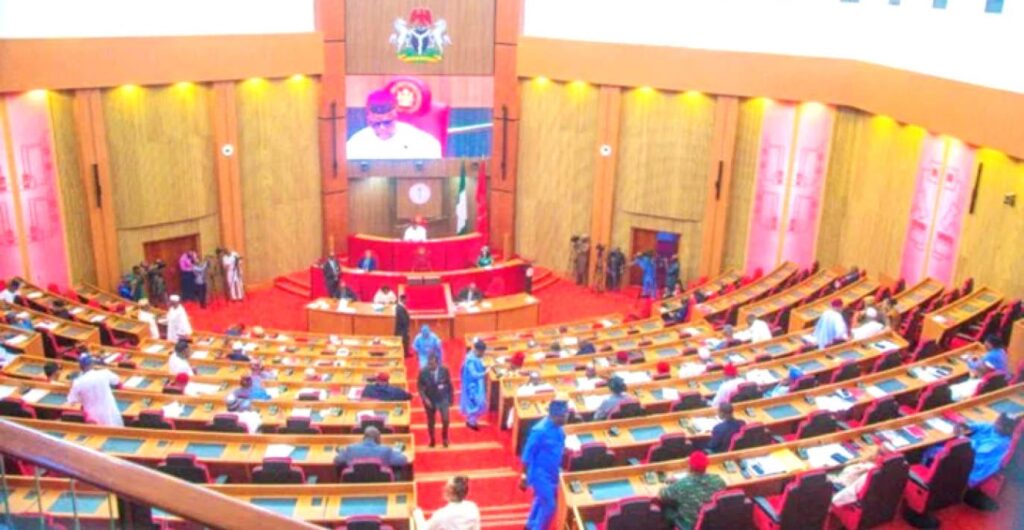
The Senate has directed the Clerk to the National Assembly, Kamoru Ogunlana, to transmit the Constitution (Sixth Alteration) Bill, 2026, seeking the establishment of state police services across Nigeria, to President Bola Tinubu for assent.
The directive followed the Senate’s confirmation that the constitutional amendment had secured the required approval of the 36 State Houses of Assembly, paving the way for its transmission to the President in accordance with the Acts Authentication Act, 2004.
The Senate also called on President Tinubu to forward the proposed National Policing Bill, which is expected to provide the operational framework for subnational policing, to the National Assembly for consideration and speedy passage.
President of the Senate, Godswill Akpabio, said the executive was expected to submit the implementation modalities for state police services to the legislature, stressing the need to move the process forward without imposing unnecessary timelines.
Akpabio, however, emphasised that time was of the essence, given the urgency of establishing an effective policing structure to address the country’s security challenges.
The constitutional amendment, titled A Bill for an Act to Alter the Constitution of the Federal Republic of Nigeria, 1999, to Provide for the Establishment of State Police Services and for Related Matters, seeks to create the legal foundation for the establishment of state police across the federation.
The Senate’s resolutions followed a motion sponsored by the Senate Leader, Opeyemi Bamidele, representing Ekiti Central Senatorial District, under the All Progressives Congress (APC).
Presenting the motion, Bamidele recalled that the National Assembly had earlier processed an executive bill seeking to amend the Constitution to accommodate state police as part of Nigeria’s national policing structure.
He said the Senate and the House of Representatives approved the bill on June 24 and July 23, 2026, respectively, with more than two-thirds majority votes, thereby satisfying the constitutional requirement for its passage by the National Assembly.
Bamidele further explained that the proposed amendment was subsequently transmitted to the 36 State Houses of Assembly for approval in line with Section 9(2) of the 1999 Constitution, which requires the support of at least two-thirds of the state legislatures.
According to him, all 36 State Houses of Assembly have now transmitted their resolutions on the bill to the National Assembly, completing the state-level approval process.