Obasanjo Slams Tinubu’s Borrowing Policy, Says Debt Worse Than Leprosy

Former President Olusegun Obasanjo has strongly criticised President Bola Ahmed Tinubu’s justification of government borrowing, describing public debt as more destructive than leprosy because of its potential to burden generations of Nigerians.
Obasanjo argued that excessive borrowing could mortgage Nigeria’s future, warning that the consequences of accumulating debts would extend beyond the present administration to generations yet unborn.
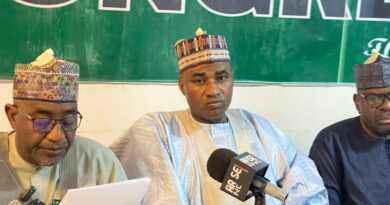
He made the remarks on Friday at the Ajibosin Platform, a public forum held in Abeokuta, Ogun State, with the theme, “Leveraging Artificial Intelligence to Solve Grassroots Problems and Accelerate National Development.”
Reacting to Tinubu’s earlier defence of borrowing, Obasanjo dismissed the President’s position, insisting that the consequences of debt accumulation were far-reaching.
The former president’s comments followed Tinubu’s April remarks that borrowing was not inherently wrong provided the government had the capacity to repay its obligations.
Obasanjo also expressed concern over Nigeria’s economic performance, particularly the persistent depreciation of the naira against the United States dollar.
Recounting his experience as a farmer, he said the naira was stronger than the dollar when he established his farm 47 years ago, questioning what had gone wrong with the country’s economic management over the decades.
He challenged political leaders to demonstrate a clear understanding of Nigeria’s challenges and provide practical solutions rather than continue policies that undermine the country’s economic prospects.
The former president equally questioned Nigeria’s reliance on economic prescriptions from the World Bank and the International Monetary Fund (IMF), arguing that the institutions were not originally established to address the specific development needs of African countries.
He urged Nigerian leaders to critically assess foreign economic policies and prioritise solutions that reflect the country’s national interests.
Obasanjo Warns Africa Against AI Colonialism
Beyond the economy, Obasanjo warned that Africa could face another form of exploitation if foreign interests were allowed to dominate the development and application of artificial intelligence.
Although acknowledging his limited technical knowledge of AI, he maintained that countries that do not control their technology remain vulnerable to manipulation and exploitation.
Drawing parallels with Africa’s experiences of slavery, colonialism and economic dependency, he urged African leaders to take ownership of emerging technologies rather than remain dependent on foreign companies.
He also questioned the benefits of technology transfer arrangements, calling on African countries to examine who controls transferred technologies and the terms under which such arrangements are made.
Obasanjo further raised concerns over Nigeria’s estimated 24 million out-of-school children, describing the situation as a major threat to the country’s future.
He urged policymakers and technology experts to explore how artificial intelligence could expand access to education and address learning challenges.
On agriculture, he advocated the use of AI to help farmers identify suitable crops, improve agricultural productivity and strengthen food and nutrition security.
Ardo Warns Against Digital Exploitation of Africa
Also speaking at the event, historian and guest speaker, Dr Umar Ardo, warned that artificial intelligence could introduce another phase of economic exploitation in Africa if the continent failed to secure ownership of its data, technological infrastructure and intellectual resources.
In a presentation titled “From Slave Ships to Server Farms: Artificial Intelligence and Africa’s Unbroken History of Extraction,” Ardo argued that while AI presents enormous opportunities for development, foreign control of the technology could deepen Africa’s economic dependence.
He traced the continent’s history of external exploitation through the transatlantic slave trade, colonial extraction of natural resources and post-independence economic dependency.
According to him, artificial intelligence and the growing value of data could represent another phase of this historical pattern, particularly as information generated by African citizens, farmers, hospitals, businesses and indigenous communities becomes increasingly valuable to the global digital economy.
Ardo warned that African data could be collected and commercialised by foreign technology companies without adequate control, compensation or benefits for the communities that generate it.
He therefore called for a comprehensive framework that would guarantee technological sovereignty, data protection, indigenous innovation and grassroots participation in the digital economy.
Calls for Indigenous AI Development
Ardo urged the Federal Government to increase investment in domestic computing infrastructure, reliable electricity, semiconductor technology, research institutions and locally developed artificial intelligence systems.
He maintained that Nigeria, with a population exceeding 230 million, should not remain merely a consumer market for foreign technological products.
He also advocated the development of indigenous datasets and AI models capable of understanding African languages, agricultural practices, traditional medicine and cultural knowledge, while ensuring appropriate ownership and safeguards.
On grassroots development, the historian recommended the deployment of AI in primary healthcare, agricultural extension services, local government administration, revenue collection, conflict resolution and disaster management.
He further called for comprehensive AI education and training programmes in universities, polytechnics and colleges of education to equip young Africans with the skills required to participate meaningfully in the emerging technological economy.
Ardo also urged Nigeria to strengthen cooperation with other African countries through harmonised data protection regulations, shared technological infrastructure and stronger continental bargaining power in dealings with international technology companies.
He identified the African Union’s Data Policy Framework, adopted in 2022, as an important foundation for achieving these objectives.
Concluding his presentation, Ardo cautioned that digital exploitation could become more difficult to detect than the extraction of physical resources, particularly when individuals voluntarily use platforms without understanding how their information is collected and commercialised.
He urged African governments to move beyond adopting foreign innovations and become active developers, owners and regulators of technologies that will shape the continent’s future.
He maintained that artificial intelligence could either reinforce Africa’s historical dependence or provide an opportunity for the continent to take greater control of its economic and technological destiny.